
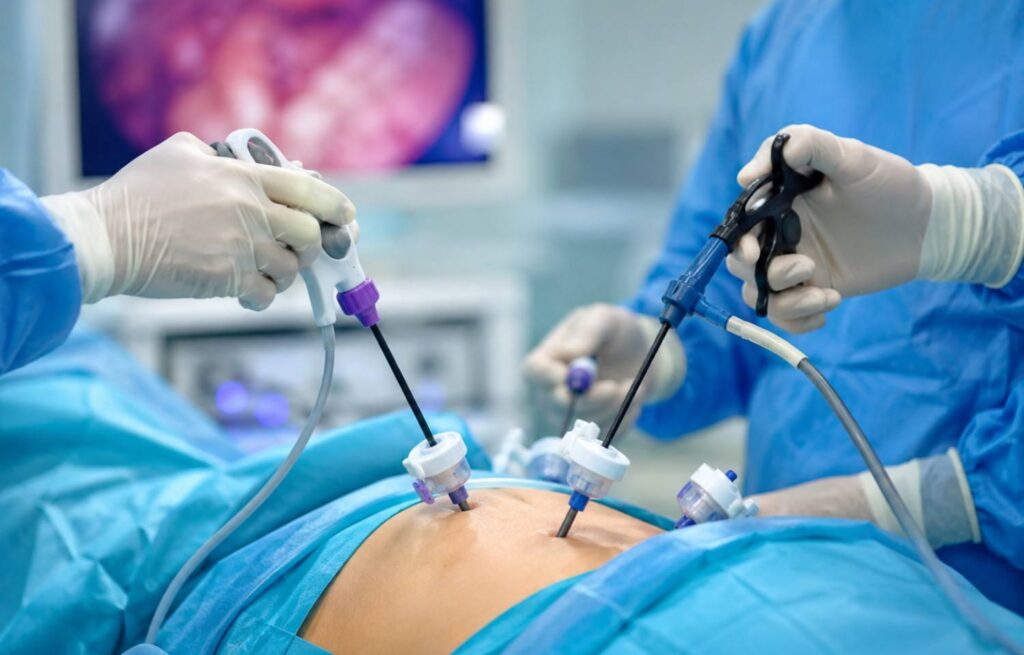
When a cancer surgery is recommended, one of the first things many patients ask is whether it has to be “open” surgery, or whether a less invasive option exists. It’s a reasonable question — the answer affects everything from scar size to how long you’ll spend in hospital. Dr. Nishanth Sanghavi, Surgical Oncologist and Director at Zanish Cancer Hospital, Ahmedabad, uses minimally invasive techniques, including robotic-assisted surgery, across a range of cancer types where they’re appropriate for the individual patient.
This page explains what minimally invasive cancer surgery actually means, how laparoscopic and robotic approaches differ, and how to know whether one might apply to your specific diagnosis.
Minimally invasive surgery is an umbrella term for surgical techniques performed through several small incisions — usually a few centimetres each — instead of one large opening. It stands in contrast to traditional open surgery, which typically requires a longer incision to give the surgeon direct visual and hands-on access to the area being treated.
Two main forms of minimally invasive surgery are used in cancer treatment today: laparoscopic surgery and robotic-assisted surgery. Both rely on small incisions and a camera to guide the operation, but they differ in how the surgeon controls the instruments — a distinction that matters more than most patients initially realise.
Laparoscopic surgery uses long, rigid instruments that the surgeon holds and manipulates directly by hand, guided by a 2D camera view displayed on a monitor. It’s been used in general and cancer surgery for decades and remains an appropriate, well-established option for many procedures.
Robotic-assisted surgery also uses small incisions, but the surgeon controls the instruments from a console, and the robotic system translates hand and wrist movement into smaller, more precise instrument motion, viewed through a magnified 3D camera rather than 2D. The wristed instruments used in robotic surgery can rotate more freely than the human hand, which is particularly useful in tight, hard-to-reach spaces — such as deep in the pelvis, or close to major blood vessels and nerves.
Neither technique is universally “better” — the right choice depends on the specific cancer, its location, and individual patient factors, which is why this decision is made case by case rather than defaulting to one approach for every patient.
Minimally invasive and robotic techniques are now used across a wide range of cancer types, including:
Not every tumour within these categories is suitable for a minimally invasive approach — size, location, and how far the cancer has spread all factor into that decision. Dr. Sanghavi’s multidisciplinary surgical practice spans uro-oncology, GI oncology, colorectal, gynaecologic oncology, head & neck oncology, and breast cancer surgery, which allows this evaluation to draw on experience across cancer types rather than a single narrow specialty.
This is one of the most important questions to ask, and it deserves an honest answer rather than a reassuring one: for many cancer types and stages, minimally invasive and robotic surgery achieve comparable cancer-clearance outcomes to open surgery, when performed on appropriately selected patients by an experienced surgical team. That qualifier — appropriately selected patients — matters. Minimally invasive surgery isn’t the right choice for every tumour, and forcing a minimally invasive approach onto a case better suited to open surgery can compromise the goal that matters most: removing the cancer completely and safely.
This is why the decision isn’t simply “minimally invasive versus open” in the abstract — it’s a judgment made about your specific tumour, discussed openly during consultation.
Where appropriate, minimally invasive approaches are generally associated with:
These benefits are meaningful, but they come with an important caveat: they apply when the technique is a good fit for the tumour being treated. Some patients — because of tumour size, location, prior surgery, or overall health — are better served by open surgery, and a good surgical oncologist will say so rather than push a minimally invasive approach that isn’t in the patient’s best interest.
Your evaluation typically begins with imaging (CT or MRI, depending on the cancer type) and, where relevant, biopsy results, to understand the tumour’s exact size, location, and stage. Dr. Sanghavi reviews this information to determine whether a robotic, laparoscopic, or open approach is most appropriate — and explains the reasoning behind that recommendation, rather than presenting it as a given.
If a minimally invasive approach is appropriate, your care team will walk you through what the specific operation involves for your particular cancer type — details that vary meaningfully between, say, bladder cancer surgery and colon cancer surgery, even though both may be performed robotically.
Dr. Nishanth Sanghavi is a Surgical Oncologist and Director at Zanish Cancer Hospital, Ahmedabad, with over 14 years of experience and more than 5,000 cancer surgeries performed. He trained in Surgical Oncology at the Gujarat Cancer and Research Institute (GCRI), Civil Hospital, Ahmedabad, and completed advanced training in laparoscopic oncosurgery under Dr. Shailesh Putambekar at Galaxy Care Institute, Pune — training specifically focused on the minimally invasive techniques this page discusses.
His surgical practice spans uro-oncology, GI oncology, colorectal, gynaecologic oncology, head & neck oncology, and breast cancer surgery, and he has served as Conference Director and Chairperson at TACOS (Thoracic and Colorectal Oncology Summit) 2026, Ahmedabad.

MBBS - 2006

M.S. in General Surgery - 2010

M.Ch. in Surgical Oncology - 2014

Advanced laparoscopic oncosurgery
The cost of minimally invasive cancer surgery in Ahmedabad depends heavily on which cancer is being treated, the extent of surgery, whether robotic or laparoscopic technique is used, and length of hospital stay. Because these factors vary so widely across cancer types, we don’t publish a single figure here — visit the procedure page relevant to your diagnosis, or book a consultation for a cost estimate specific to your case.
Zanish Cancer Hospital accepts insurance, including Mediclaim policies — call the hospital to discuss coverage details relevant to your policy.
If you’ve received a cancer diagnosis and want to understand whether a minimally invasive approach might apply to your case, a consultation is the best next step — or, if you already have a treatment recommendation from elsewhere, a second opinion is a reasonable option before deciding on surgery.
Lorem Ipsum is simply dummy text of the printing and typesetting industry. Lorem Ipsum has been the industry’s standard dummy text ever since.
Laparoscopic surgery is performed with hand-held instruments guided by a 2D camera. Robotic surgery uses a console-controlled system with wristed instruments and a magnified 3D view, offering greater precision in tight spaces — but both are minimally invasive techniques.
Yes, for many cancer types and stages, when the patient is appropriately selected and the surgery is performed by an experienced team. It isn’t the right fit for every tumour, which is why individual evaluation matters.
For appropriately selected cases, outcomes are generally comparable. The key factor is whether the specific tumour is suited to a minimally invasive approach — not the technique itself.
A wide range, including urologic, colorectal, select gastrointestinal, gynaecologic, and select breast and head & neck cancers. Suitability depends on the specific tumour.
This is determined by your imaging, biopsy results, and overall health, reviewed during consultation. Your surgeon will explain which approach — robotic, laparoscopic, or open — is recommended for your case and why.
Cost depends on the cancer type, extent of surgery, and hospital stay. Book a consultation for a personalised estimate.

Lorem ipsum dolor sit amet consectetur. Tempus libero lectus id velit fermentum et tempus egestas lobortis.
Copyright © 2023 Wise Doctor By Evonicmedia All Rights Reserved.
Powered by Evonicsoft

Advancing Cancer Care Through Robotic Precision
Zanish Cancer Hospital is committed to providing advanced cancer care through modern robotic surgery, comprehensive treatment, and compassionate care for every patient.
This will close in 0 seconds