
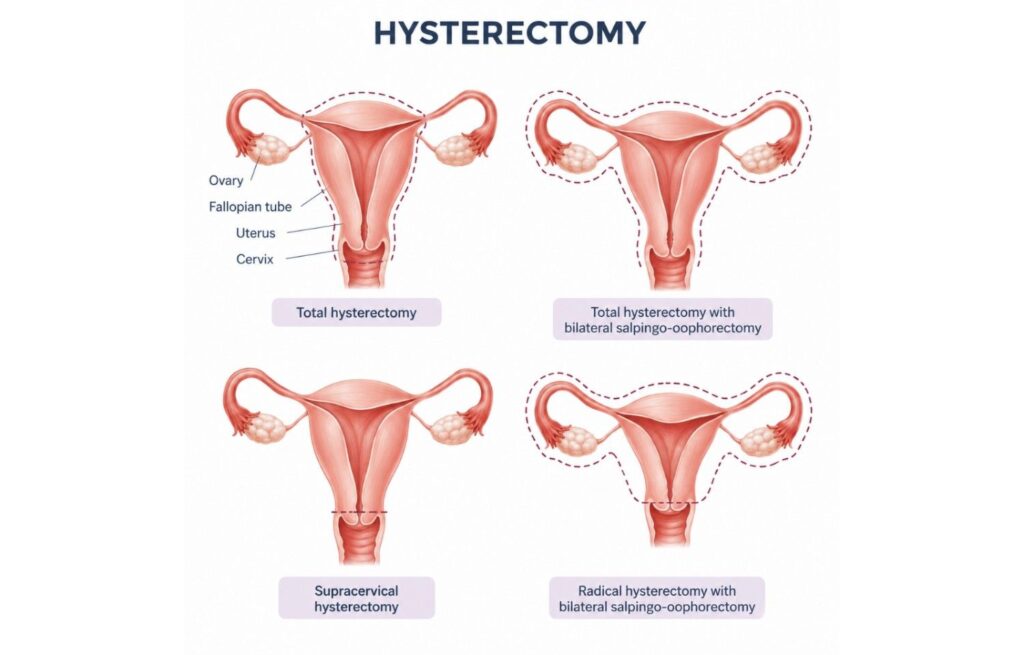
Hysterectomy is a word many people have heard in a non-cancer context — for fibroids, heavy bleeding, or other benign conditions. When it’s recommended as cancer treatment, the surgery itself involves the same core procedure, but the reasoning, the extent of what’s removed, and the follow-up are different. At Zanish Cancer Hospital in Ahmedabad, Dr. Nishant Sanghavi and team perform robotic-assisted hysterectomy for uterine and other gynecologic cancers, with a clear explanation of how this specific version of the surgery differs from a routine one.
A robotic hysterectomy for cancer is a minimally invasive surgery that removes the uterus — and, in most cancer cases, the cervix, ovaries, fallopian tubes, and nearby pelvic lymph nodes — using a robotic-assisted surgical system. The surgeon operates through several small incisions from a console, directing every instrument movement in real time while viewing the surgical field in magnified 3D.
This procedure is most commonly used to treat endometrial cancer (cancer of the uterine lining), which is the gynecologic cancer most directly treated by hysterectomy. It differs from a hysterectomy done for fibroids or heavy bleeding in one key way: cancer surgery typically also involves removing the ovaries, fallopian tubes, and lymph nodes for staging, whereas a benign hysterectomy may preserve the ovaries and doesn’t require lymph node evaluation.
For a benign hysterectomy, only the uterus (and sometimes cervix) needs to come out. For a cancer hysterectomy, the surgical team also evaluates and often removes pelvic — and sometimes para-aortic — lymph nodes. This step exists to answer one specific question: has the cancer spread beyond the uterus? The answer directly determines whether additional treatment, such as chemotherapy or radiation, is needed afterward. This is a meaningful part of why cancer hysterectomy is a more involved procedure than its benign counterpart, even though both are commonly called by the same name.
Compared with traditional open hysterectomy for cancer, the robotic approach typically involves:
For most early-stage endometrial cancer, minimally invasive approaches including robotic surgery are well-established and widely used. Dr. Sanghavi will confirm whether robotic surgery is appropriate based on your specific tumor grade, stage, and any relevant imaging findings.
Robotic hysterectomy is generally suitable for patients with endometrial cancer confined to the uterus, or with limited spread, who are medically fit for surgery under general anesthesia. Body weight and prior abdominal surgeries can sometimes affect surgical planning, but often don’t rule out a robotic approach the way they might with open or standard laparoscopic surgery — this is one area where robotic technology can actually widen who’s eligible for a minimally invasive option. More advanced disease, or cancer types other than endometrial that require a different surgical extent, are evaluated individually.
Before surgery: Your workup typically includes endometrial biopsy or pathology results, pelvic imaging, and a pre-anesthesia fitness review. Dr. Sanghavi will also discuss what will be removed in your specific case, including whether ovarian preservation is medically appropriate at your age and stage — for younger patients, this is worth raising directly.
During surgery: Performed under general anesthesia, the procedure generally takes a few hours, including lymph node evaluation.
After surgery: Most patients spend one to two days in hospital, with recovery generally faster than after open surgery. Final pathology from the removed tissue and lymph nodes determines whether further treatment is needed, and this is discussed at a follow-up visit once results are available.
A frequent question is whether this surgery causes early menopause. If both ovaries are removed as part of the cancer surgery — which is typical for postmenopausal patients and often recommended even for some younger patients depending on cancer type — this does bring on surgical menopause for those who haven’t already gone through it naturally. Another common question is how this differs from a “normal” hysterectomy a friend or relative may have had for a benign condition; the honest answer is that the core surgery is similar, but the additional lymph node evaluation and ovarian removal specific to cancer treatment make it a more extensive procedure, with a recovery that’s broadly similar but staging results that carry more significance afterward.
Dr. Nishant Sanghavi is a surgical oncologist with over 16 years of experience and more than 6,000 cancer surgeries performed, practicing at Zanish Cancer Hospital in Naranpura, Ahmedabad, where he has served as Director and Consultant Surgical Oncologist since March 2018. He completed his MBBS at Smt. NHL Municipal Medical College, Ahmedabad (2006), his M.S. in General Surgery at Smt. NHL Municipal Medical College, Shardaben Hospital (2010), and his M.Ch in Surgical Oncology at the Gujarat Cancer and Research Institute (GCRI), Civil Hospital, Ahmedabad (2014).
He trained further in advanced laparoscopic oncosurgery under Dr. Shailesh Putambekar at Galaxy Care Institute, Pune, and has served as Conference Director and Chairperson at national oncology forums, including the Thoracic and Colorectal Oncology Summit (TACOS) 2026 in Ahmedabad. His surgical focus includes gynecologic oncology — covering endometrial, ovarian, and cervical cancers — alongside uro-oncology, GI oncology, head & neck oncology, breast cancer surgery, and soft tissue sarcoma.

MBBS - 2006

M.S. in General Surgery - 2010

M.Ch. in Surgical Oncology - 2014

Advanced laparoscopic oncosurgery
The cost of robotic hysterectomy for cancer depends on the extent of surgery, whether lymph node dissection is required, hospital stay duration, and any follow-up treatment. Rather than quoting a generic figure, our team provides a personalized estimate during consultation and can walk you through insurance and Mediclaim coverage where applicable.
If you’ve already received a diagnosis or surgical recommendation elsewhere, a second opinion is a reasonable and common step. Dr. Sanghavi reviews your pathology and imaging to confirm whether robotic hysterectomy is the right approach for your specific cancer type and stage.
Zanish Cancer Hospital is located on the 1st Floor, Viva Atelier, Opp. B.D. Patel House, Near Sardar Patel Statue, Naranpura, Ahmedabad, serving patients across Ahmedabad and Gujarat, including SG Highway, Bodakdev, Satellite, and Prahlad Nagar, as well as international patients traveling from the USA, UAE, and UK.
Lorem Ipsum is simply dummy text of the printing and typesetting industry. Lorem Ipsum has been the industry’s standard dummy text ever since.
Yes — it’s a well-established surgical approach with the surgeon in full control throughout. Individual risks depend on your case and are discussed in detail at consultation.
Robotic surgery uses smaller incisions and a robotic-assisted system for greater precision, generally leading to less blood loss, less pain, and a shorter hospital stay than open surgery. Suitability depends on tumour size, location, and your overall health.
Not always. In most cases the colon is reconnected during the same surgery. A temporary or permanent colostomy is needed only in specific situations, which your surgeon will discuss with you beforehand.
Recovery is generally faster than after open surgery, but timeframes vary by the extent of surgery and individual health. Your care team will provide a personalised recovery outlook.
Cost depends on the extent of surgery, hospital stay, and any additional treatment. Book a consultation for a personalised estimate.
Yes, Zanish Cancer Hospital accepts insurance including Mediclaim. Call +91 7433852300 for details specific to your policy.

Lorem ipsum dolor sit amet consectetur. Tempus libero lectus id velit fermentum et tempus egestas lobortis.
Copyright © 2023 Wise Doctor By Evonicmedia All Rights Reserved.
Powered by Evonicsoft

Advancing Cancer Care Through Robotic Precision
Zanish Cancer Hospital is committed to providing advanced cancer care through modern robotic surgery, comprehensive treatment, and compassionate care for every patient.
This will close in 0 seconds