
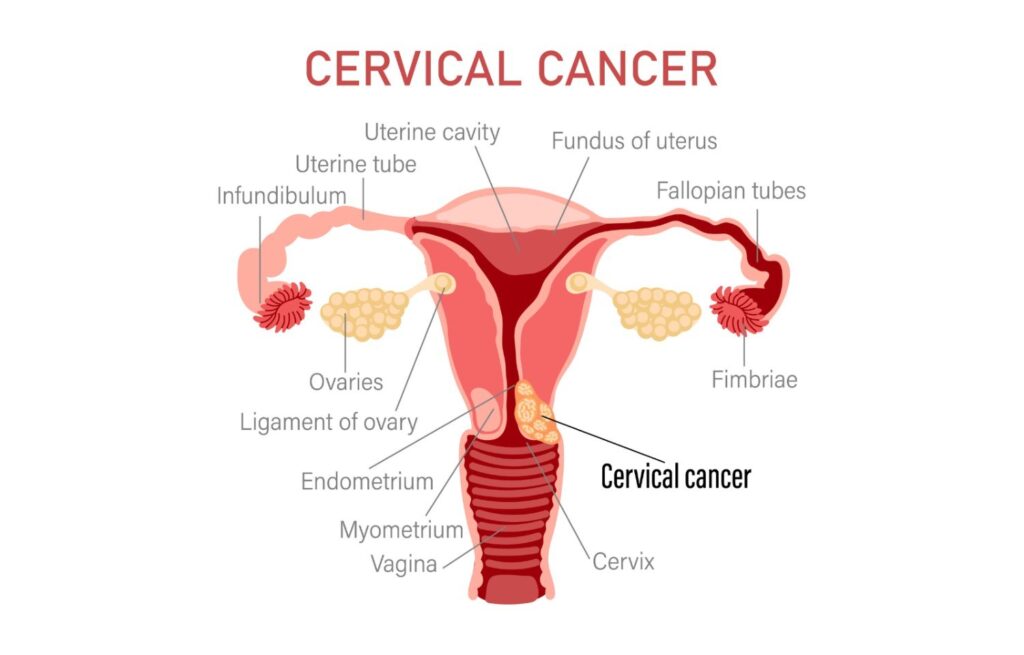
An abnormal Pap smear or HPV test result that leads to a cervical cancer diagnosis often comes earlier in a woman’s life than other cancers, which brings its own set of concerns — particularly around fertility and future family planning. At Zanish Cancer Hospital in Ahmedabad, Dr. Nishant Sanghavi and team offer robotic-assisted cervical cancer surgery for appropriate early-stage disease, along with a direct conversation about what your specific stage and priorities mean for the surgical plan.
Robotic cervical cancer surgery most often refers to a robotic-assisted radical hysterectomy — removal of the uterus, cervix, and surrounding tissue, along with pelvic lymph nodes, to treat early-stage cervical cancer. The surgeon operates through several small incisions using a robotic-assisted surgical system, working from a console throughout the procedure while viewing the surgical field in magnified 3D.
Cervical cancer treatment depends heavily on stage. Surgery is generally the primary treatment for early-stage disease confined to the cervix, while more locally advanced or spread disease is typically managed with radiation and chemotherapy rather than surgery. Getting this staging right is the single most important step before any surgical plan is made.
For early-stage cervical cancer, there are two broad surgical paths, and which one applies depends on the tumor’s size, depth, and your own priorities:
Trachelectomy is only appropriate for a specific subset of early cervical cancers — generally small tumors with no evidence of deeper spread — and requires careful evaluation to confirm it’s oncologically safe in your specific case. It’s a real option for some patients, not all, and Dr. Nishant Sanghavi is candid about whether it applies to your particular diagnosis rather than offering it as a default.
For appropriate early-stage cases, the robotic approach typically involves:
It’s worth noting that in recent years, evidence has prompted more careful patient selection for minimally invasive (including robotic) radical hysterectomy in cervical cancer specifically, compared with some other gynecologic cancers — this is exactly the kind of nuance Dr. Sanghavi discusses openly, explaining why the surgical approach he recommends is based on your specific tumor characteristics rather than a general preference for one technique.
Robotic radical hysterectomy or trachelectomy is generally considered for patients with early-stage cervical cancer confined to the cervix, with tumors below a certain size, and who are medically fit for surgery. Locally advanced cervical cancer — where the tumor has grown beyond the cervix or into nearby structures — is typically treated with chemoradiation rather than surgery, since outcomes for this stage are generally better with that approach. An accurate diagnosis and staging always comes before deciding whether surgery, and which type, is appropriate.
Before surgery: Your workup typically includes biopsy and pathology results, pelvic exam findings, and imaging (usually MRI) to assess tumor size and depth of invasion — all of which determine whether surgery, and which surgical option, is appropriate.
During surgery: Performed under general anesthesia, robotic radical hysterectomy or trachelectomy generally takes a few hours, including lymph node evaluation.
After surgery: Most patients spend a few days in hospital, with recovery generally faster than after open surgery. Final pathology results guide whether any additional treatment is needed, and follow-up visits continue afterward to monitor recovery and screen for recurrence.
The question that comes up most is whether fertility can realistically be preserved. The honest answer is that it depends entirely on the tumor’s characteristics — trachelectomy is a genuine option for select small, early tumors, but isn’t appropriate when the cancer is larger or has spread more than initially suspected on imaging. Some patients who hope for trachelectomy going in learn during workup that radical hysterectomy is the safer path for their specific case; this is discussed clearly before surgery, based on your actual pathology, rather than assumed either way.
Dr. Nishant Sanghavi is a surgical oncologist with over 14 years of experience and more than 5,000 cancer surgeries performed, practicing at Zanish Cancer Hospital in Naranpura, Ahmedabad, where he has served as Director and Consultant Surgical Oncologist since March 2018. He completed his MBBS at Smt. NHL Municipal Medical College, Ahmedabad (2006), his M.S. in General Surgery at Smt. NHL Municipal Medical College, Shardaben Hospital (2010), and his M.Ch in Surgical Oncology at the Gujarat Cancer and Research Institute (GCRI), Civil Hospital, Ahmedabad (2014).
He trained further in advanced laparoscopic oncosurgery under Dr. Shailesh Putambekar at Galaxy Care Institute, Pune, and has served as Conference Director and Chairperson at national oncology forums, including the Thoracic and Colorectal Oncology Summit (TACOS) 2026 in Ahmedabad.
His surgical focus includes gynecologic oncology — covering cervical, uterine, and ovarian cancers — alongside uro-oncology, GI oncology, head & neck oncology, breast cancer surgery, and soft tissue sarcoma.

MBBS - 2006

M.S. in General Surgery - 2010

M.Ch. in Surgical Oncology - 2014

Advanced laparoscopic oncosurgery
The cost of robotic cervical cancer surgery depends on whether radical hysterectomy or trachelectomy is performed, the extent of lymph node evaluation, hospital stay duration, and any additional treatment needed. Rather than quoting a generic figure, our team provides a personalized estimate during consultation and can walk you through insurance and Mediclaim coverage where applicable.
If you’ve already received a diagnosis or surgical recommendation elsewhere, a second opinion is a reasonable and common step, particularly when fertility preservation is part of the decision. Dr. Nishant Sanghavi reviews your pathology and imaging to discuss whether robotic surgery, a fertility-sparing approach, or chemoradiation fits your case.
Zanish Cancer Hospital is located on the 1st Floor, Viva Atelier, Opp. B.D. Patel House, Near Sardar Patel Statue, Naranpura, Ahmedabad, serving patients across Ahmedabad and Gujarat, including SG Highway, Bodakdev, Satellite, and Prahlad Nagar, as well as international patients traveling from the USA, UAE, and UK.
Lorem Ipsum is simply dummy text of the printing and typesetting industry. Lorem Ipsum has been the industry’s standard dummy text ever since.
Colon cancer surgery removes part of the colon and typically reconnects the bowel in the same operation. Rectal cancer surgery is performed deeper in the pelvis, often involves pre-surgical chemoradiation, and more frequently requires a temporary stoma.
Yes — robotic techniques are well established for both, though the specific operation performed differs based on tumour location.
Yes — it’s a well-established approach with the surgeon in full control throughout. Individual risks vary by procedure and are discussed in detail at consultation.
This is determined by your colonoscopy and biopsy findings, based on the tumour’s exact location within the large intestine. Your surgeon will clarify this early in your evaluation.
Cost varies depending on whether the procedure is for colon or rectal cancer, and the extent of surgery involved. Book a consultation for a personalised estimate.
Yes, Zanish Cancer Hospital accepts insurance including Mediclaim. Call +91 7433852300 for details specific to your policy.

Lorem ipsum dolor sit amet consectetur. Tempus libero lectus id velit fermentum et tempus egestas lobortis.
Copyright © 2023 Wise Doctor By Evonicmedia All Rights Reserved.
Powered by Evonicsoft

Advancing Cancer Care Through Robotic Precision
Zanish Cancer Hospital is committed to providing advanced cancer care through modern robotic surgery, comprehensive treatment, and compassionate care for every patient.
This will close in 0 seconds