
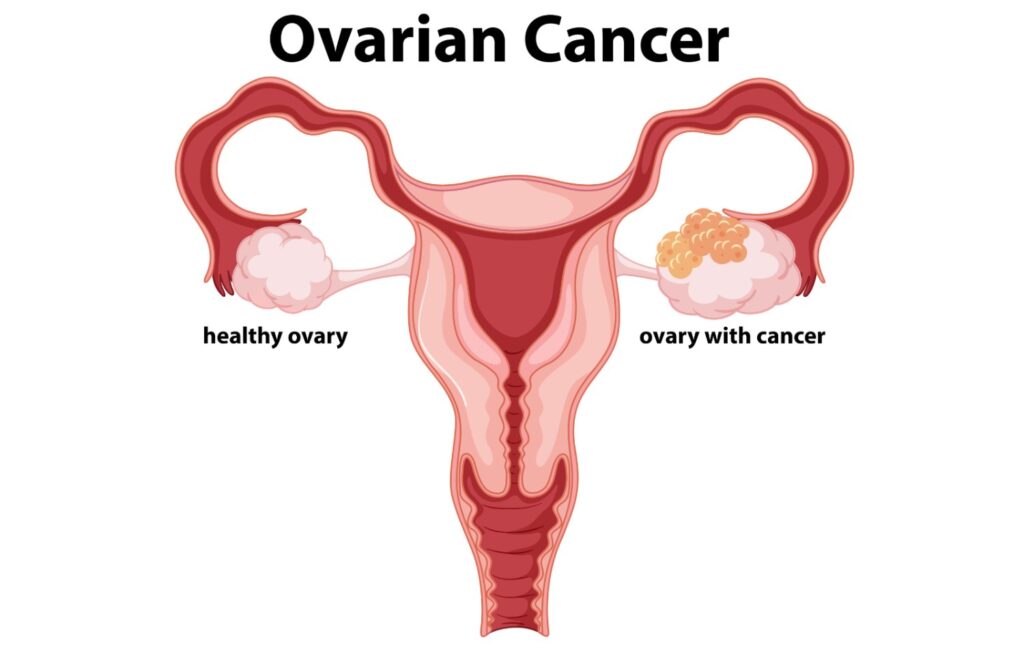
An ovarian mass finding is unsettling in a specific way — because until surgery or a biopsy confirms it, there’s often genuine uncertainty about whether it’s cancer at all. At Zanish Cancer Hospital in Ahmedabad, Dr. Nishant Sanghavi and team offer robotic-assisted ovarian cancer surgery both for diagnosis and treatment, with a clear explanation at every step of what’s known, what’s still uncertain, and what the surgical plan involves.
Robotic ovarian cancer surgery uses a robotic-assisted surgical system to remove the ovaries and, depending on the case, surrounding tissue affected by cancer — through several small incisions rather than one large abdominal cut. The surgeon operates from a console throughout, guiding every instrument movement in real time while viewing the surgical field in magnified 3D.
Ovarian cancer surgery serves two purposes at once: removing the cancer, and accurately staging it — meaning determining exactly how far it has spread, which directly shapes what treatment comes next. This staging role is one reason precision matters so much in this particular surgery.
One thing that surprises many patients: sometimes it isn’t fully clear whether an ovarian mass is cancerous until it’s examined during surgery itself. Imaging and blood markers (such as CA-125) help estimate the likelihood beforehand, but a definitive answer often comes from pathology during or after the operation. This is why the surgical plan is sometimes discussed as having a few possible paths depending on what’s found — Dr. Nishant Sanghavi explains this upfront, so it doesn’t come as a surprise mid-process.
Two terms come up often in ovarian cancer surgery, and they’re worth understanding plainly:
Early-stage ovarian cancer confined to one or both ovaries is generally more suited to a robotic, minimally invasive approach. More advanced disease with widespread spread throughout the abdomen may require a different, often open, surgical strategy to achieve thorough cytoreduction — robotic surgery isn’t the right fit for every stage, and Dr. Nishant Sanghavi is direct about which approach applies to your case based on imaging and, where needed, surgical findings.
For younger women diagnosed with early-stage ovarian cancer, whether it’s possible to preserve the unaffected ovary and uterus is often a central concern. In carefully selected early-stage cases, fertility-sparing surgery — removing only the affected ovary while preserving the other side and the uterus — may be appropriate. This isn’t suitable for every diagnosis and depends heavily on cancer type, stage, and grade. Dr. Nishant Sanghavi discusses this specifically and honestly based on your pathology, rather than offering false reassurance where it isn’t medically appropriate.
For appropriately selected, earlier-stage cases, the robotic approach typically involves:
For advanced-stage disease requiring extensive cytoreduction, open surgery often remains the more appropriate approach to achieve thorough tumor removal — a fact Dr. Nishant Sanghavi will discuss plainly rather than defaulting to robotic surgery regardless of stage.
Before surgery: Your workup typically includes pelvic ultrasound or CT/MRI imaging, tumor marker blood tests (such as CA-125), and a detailed discussion of the possible surgical paths depending on what’s found.
During surgery: Performed under general anesthesia, the procedure length varies significantly depending on whether it’s primarily diagnostic staging or more extensive cancer removal.
After surgery: Most patients spend a few days in hospital. Depending on the final staging results, chemotherapy is often part of the treatment plan afterward — this is common for ovarian cancer and doesn’t necessarily mean surgery wasn’t successful; it reflects how ovarian cancer is typically treated as a combination of surgery and systemic therapy.
Patients often ask whether needing chemotherapy after surgery means something went wrong. It doesn’t — for many ovarian cancer stages, combining surgery with chemotherapy is the standard, expected approach, not a sign of a poor outcome. Another common concern is menopause resulting from ovary removal; when both ovaries are removed, this does bring on surgical menopause, and the care team discusses symptom management ahead of time. These specifics are addressed directly based on your case and stage, not with generic reassurance.
Dr. Nishant Sanghavi is a surgical oncologist with over 16 years of experience and more than 6,000 cancer surgeries performed, practicing at Zanish Cancer Hospital in Naranpura, Ahmedabad, where he has served as Director and Consultant Surgical Oncologist since March 2018. He completed his MBBS at Smt. NHL Municipal Medical College, Ahmedabad (2006), his M.S. in General Surgery at Smt. NHL Municipal Medical College, Shardaben Hospital (2010), and his M.Ch in Surgical Oncology at the Gujarat Cancer and Research Institute (GCRI), Civil Hospital, Ahmedabad (2014).
He trained further in advanced laparoscopic oncosurgery under Dr. Shailesh Putambekar at Galaxy Care Institute, Pune, and has served as Conference Director and Chairperson at national oncology forums, including the Thoracic and Colorectal Oncology Summit (TACOS) 2026 in Ahmedabad.
His surgical focus includes gynecologic oncology — covering ovarian, uterine, and cervical cancers — alongside uro-oncology, GI oncology, head & neck oncology, breast cancer surgery, and soft tissue sarcoma.

MBBS - 2006

M.S. in General Surgery - 2010

M.Ch. in Surgical Oncology - 2014

Advanced laparoscopic oncosurgery
The cost of robotic ovarian cancer surgery depends on whether the procedure is primarily diagnostic or involves extensive staging/cytoreduction, hospital stay duration, and whether chemotherapy is part of the treatment plan. Rather than quoting a generic figure, our team provides a personalized estimate during consultation and can walk you through insurance and Mediclaim coverage where applicable.
If you’ve had an ovarian mass flagged on imaging or already received a diagnosis elsewhere, a second opinion is a reasonable and common step, especially given how much ovarian cancer surgical planning depends on precise staging. Dr. Nishant Sanghavi reviews your imaging and tumor marker results to discuss whether robotic surgery, a fertility-sparing option, or a different surgical approach fits your situation.
Zanish Cancer Hospital is located on the 1st Floor, Viva Atelier, Opp. B.D. Patel House, Near Sardar Patel Statue, Naranpura, Ahmedabad, serving patients across Ahmedabad and Gujarat, including SG Highway, Bodakdev, Satellite, and Prahlad Nagar, as well as international patients traveling from the USA, UAE, and UK.
Lorem Ipsum is simply dummy text of the printing and typesetting industry. Lorem Ipsum has been the industry’s standard dummy text ever since.
Laparoscopic surgery is performed with hand-held instruments guided by a 2D camera. Robotic surgery uses a console-controlled system with wristed instruments and a magnified 3D view, offering greater precision in tight spaces — but both are minimally invasive techniques.
Yes, for many cancer types and stages, when the patient is appropriately selected and the surgery is performed by an experienced team. It isn’t the right fit for every tumour, which is why individual evaluation matters.
For appropriately selected cases, outcomes are generally comparable. The key factor is whether the specific tumour is suited to a minimally invasive approach — not the technique itself.
A wide range, including urologic, colorectal, select gastrointestinal, gynaecologic, and select breast and head & neck cancers. Suitability depends on the specific tumour.
This is determined by your imaging, biopsy results, and overall health, reviewed during consultation. Your surgeon will explain which approach — robotic, laparoscopic, or open — is recommended for your case and why.
Cost depends on the cancer type, extent of surgery, and hospital stay. Book a consultation for a personalised estimate.

Lorem ipsum dolor sit amet consectetur. Tempus libero lectus id velit fermentum et tempus egestas lobortis.
Copyright © 2023 Wise Doctor By Evonicmedia All Rights Reserved.
Powered by Evonicsoft

Advancing Cancer Care Through Robotic Precision
Zanish Cancer Hospital is committed to providing advanced cancer care through modern robotic surgery, comprehensive treatment, and compassionate care for every patient.
This will close in 0 seconds