
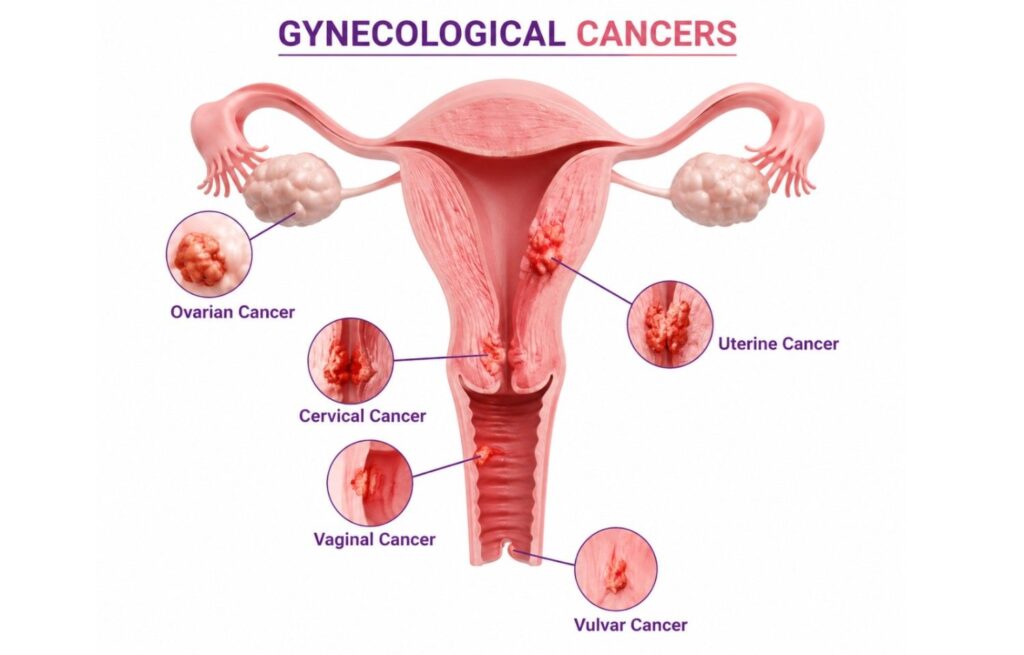
A gynecologic cancer diagnosis — whether it involves the uterus, ovaries, or cervix — often brings questions that go well beyond the cancer itself, touching on fertility, hormones, and what recovery will actually feel like. At Zanish Cancer Hospital in Ahmedabad, Dr. Nishant Sanghavi and team offer robotic-assisted gynecologic oncology surgery as a treatment option, paired with a direct, personalized conversation about what your specific diagnosis means for your body and your priorities.
Robotic gynecologic oncology surgery uses a robotic-assisted surgical system to treat cancers of the female reproductive organs — most commonly the uterus (endometrial cancer), ovaries, and cervix — through several small incisions instead of one large abdominal cut. The surgeon operates from a console throughout the procedure, guiding every instrument movement in real time while viewing the surgical field in magnified 3D.
Depending on the diagnosis, robotic surgery may involve a hysterectomy (removal of the uterus), removal of the ovaries and fallopian tubes, or lymph node evaluation to check whether cancer has spread — sometimes a combination of these. The precise procedure depends entirely on which organ is affected, the stage of disease, and your individual anatomy.
Gynecologic cancer isn’t one condition, and treatment differs meaningfully depending on where it starts:
Because these cancers behave differently, the surgical plan — and whether robotic surgery is even the right approach — depends on your specific diagnosis and stage. Dr. Sanghavi determines this based on your pathology and imaging rather than applying one template to every gynecologic cancer.
For younger patients, whether surgery affects the ability to have children in the future is often the very first question, and it deserves a direct answer. In select cases of early-stage disease — particularly some early cervical or endometrial cancers — fertility-preserving surgery may be an option, where only part of the reproductive organs is removed. This isn’t appropriate for every diagnosis or stage, and it requires careful case-by-case evaluation. For patients whose ovaries need to be removed, this also means surgical menopause, with hormonal changes that Dr. Sanghavi’s team discusses openly, including how symptoms are typically managed afterward. These conversations happen before surgery, not after, so you can weigh in on decisions that affect you long-term.
Compared with traditional open gynecologic cancer surgery, the robotic approach typically involves:
As with any cancer surgery, the right approach depends on your specific diagnosis, stage, and anatomy — Dr. Sanghavi will explain whether robotic surgery is appropriate for your case rather than assuming it universally applies.
Before surgery: Your workup typically includes biopsy or pathology results, imaging (ultrasound, CT, or MRI depending on the cancer type), and a detailed discussion of what the surgery will involve — including fertility and hormonal implications specific to your case.
During surgery: Performed under general anesthesia, robotic gynecologic surgery generally takes a few hours, depending on the extent of the procedure and any lymph node evaluation required.
After surgery: Most patients spend one to a few days in hospital, with recovery generally faster than after open surgery. Depending on the diagnosis, some patients also need additional treatment such as chemotherapy or radiation afterward, which your care team will discuss based on final pathology results.
Beyond fertility and hormones, patients often ask about the emotional and physical impact of these surgeries on intimacy and daily life. These are valid concerns, and outcomes vary based on the extent of surgery needed and individual factors. Dr. Sanghavi’s team takes these conversations seriously and can also connect patients with supportive resources as part of a broader, multidisciplinary approach to care — not just the surgical piece alone.
Dr. Nishant Sanghavi is a surgical oncologist with over 16+ years of experience and more than 6,000 cancer surgeries performed, practicing at Zanish Cancer Hospital in Naranpura, Ahmedabad, where he has served as Director and Consultant Surgical Oncologist since March 2018. He completed his MBBS at Smt. NHL Municipal Medical College, Ahmedabad (2006), his M.S. in General Surgery at Smt. NHL Municipal Medical College, Shardaben Hospital (2010), and his M.Ch in Surgical Oncology at the Gujarat Cancer and Research Institute (GCRI), Civil Hospital, Ahmedabad (2014).
He trained further in advanced laparoscopic oncosurgery under Dr. Shailesh Putambekar at Galaxy Care Institute, Pune, and has served as Conference Director and Chairperson at national oncology forums, including the Thoracic and Colorectal Oncology Summit (TACOS) 2026 in Ahmedabad.
His surgical focus includes gynecologic oncology — covering uterine, ovarian, and cervical cancers — alongside uro-oncology, GI oncology, head & neck oncology, breast cancer surgery, and soft tissue sarcoma.

MBBS - 2006

M.S. in General Surgery - 2010

M.Ch. in Surgical Oncology - 2014

Advanced laparoscopic oncosurgery
The cost of robotic gynecologic oncology surgery depends on the type and extent of surgery needed, whether lymph node evaluation or additional procedures are required, hospital stay duration, and any follow-up treatment. Rather than quoting a generic figure, our team provides a personalized estimate during consultation and can walk you through insurance and Mediclaim coverage where applicable.
If you’ve already received a diagnosis or surgical recommendation elsewhere, a second opinion is a reasonable and common step, particularly when fertility preservation is part of the decision. Dr. Nishant Sanghavi reviews your pathology and imaging to discuss whether robotic surgery, a fertility-sparing approach, or chemoradiation fits your case.
Zanish Cancer Hospital is located on the 1st Floor, Viva Atelier, Opp. B.D. Patel House, Near Sardar Patel Statue, Naranpura, Ahmedabad, serving patients across Ahmedabad and Gujarat, including SG Highway, Bodakdev, Satellite, and Prahlad Nagar, as well as international patients traveling from the USA, UAE, and UK.
Lorem Ipsum is simply dummy text of the printing and typesetting industry. Lorem Ipsum has been the industry’s standard dummy text ever since.
Colon cancer surgery removes part of the colon and typically reconnects the bowel in the same operation. Rectal cancer surgery is performed deeper in the pelvis, often involves pre-surgical chemoradiation, and more frequently requires a temporary stoma.
Yes — robotic techniques are well established for both, though the specific operation performed differs based on tumour location.
Yes — it’s a well-established approach with the surgeon in full control throughout. Individual risks vary by procedure and are discussed in detail at consultation.
This is determined by your colonoscopy and biopsy findings, based on the tumour’s exact location within the large intestine. Your surgeon will clarify this early in your evaluation.
Cost varies depending on whether the procedure is for colon or rectal cancer, and the extent of surgery involved. Book a consultation for a personalised estimate.
Yes, Zanish Cancer Hospital accepts insurance including Mediclaim. Call +91 7433852300 for details specific to your policy.

Lorem ipsum dolor sit amet consectetur. Tempus libero lectus id velit fermentum et tempus egestas lobortis.
Copyright © 2023 Wise Doctor By Evonicmedia All Rights Reserved.
Powered by Evonicsoft

Advancing Cancer Care Through Robotic Precision
Zanish Cancer Hospital is committed to providing advanced cancer care through modern robotic surgery, comprehensive treatment, and compassionate care for every patient.
This will close in 0 seconds